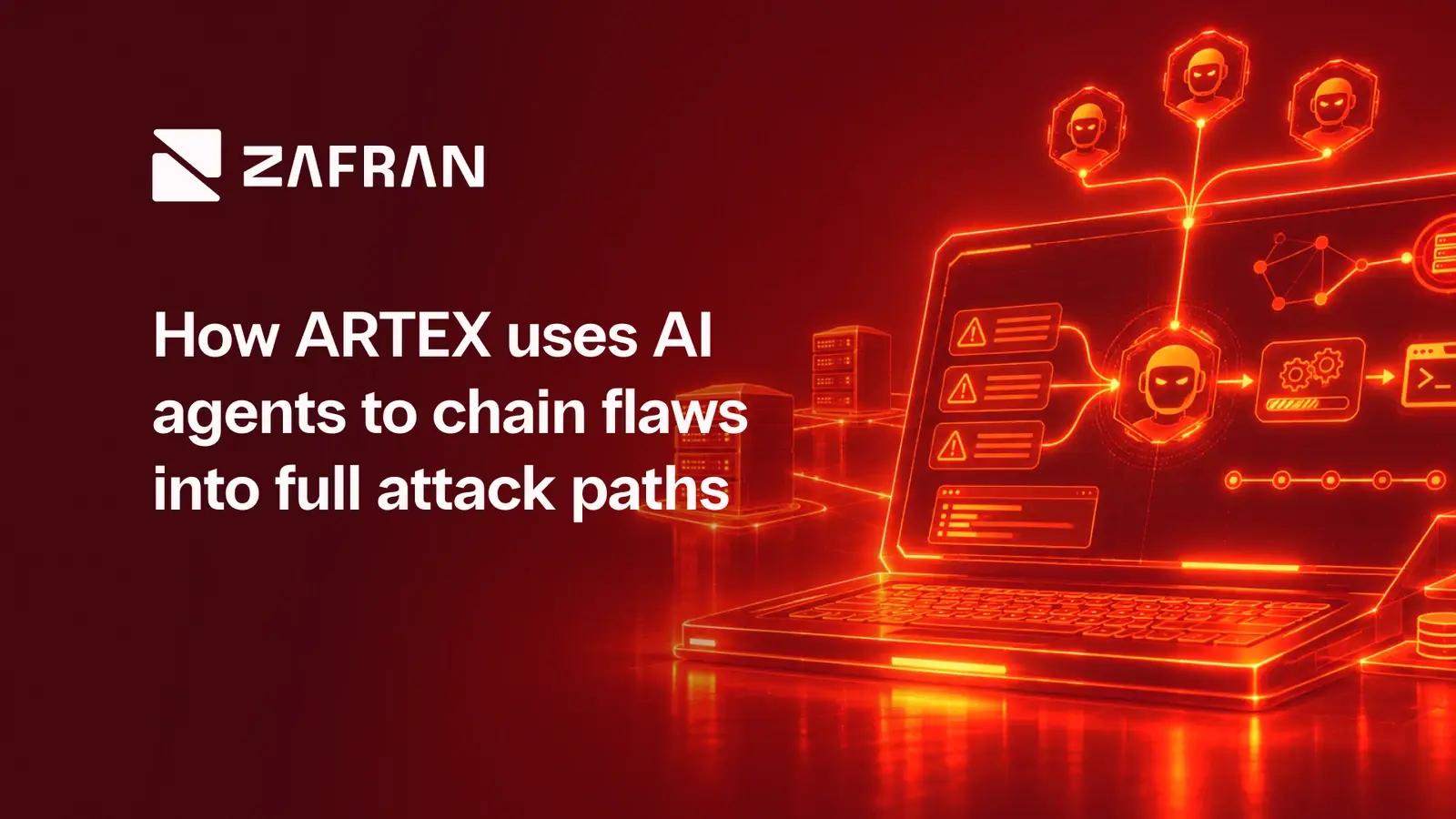
Since at least August, one open-source AI tool has been tied to data theft at South Korean banks, a supply chain compromise that went after more than 2,250 Microsoft 365 tenants, and an espionage campaign against more than 200 organizations in at least 14 countries. It’s called ARTEX, and it is the clearest sign yet that AI-driven intrusion has gone industrial. Its agents chain known CVEs and misconfigurations into full attack paths, targeting the flaws most organizations never get around to fixing.
What is ARTEX?
ARTEX is an open-source penetration-testing framework from a Chinese developer, published on GitHub in mid-2026. It is an orchestrator rather than a model. A planner agent and worker agents share a graph of facts, findings, and goals, and drive whichever LLM the operator plugs in, whether Claude and GPT or Chinese-origin models such as DeepSeek, GLM, and Kimi.
In practice that means reconnaissance, exploitation, lateral movement, and data exfiltration, run in parallel across many targets. The agents map each target’s exposed surface, test it for misconfigurations and vulnerabilities, and chain whatever they find. When a request fails, the agent retries it within seconds. Speed and volume stand out. Some intrusions go from picking a target to privileged access in under three hours, and sign-in attempts reached about 2,900 per minute.
The developer pulled the repository and went closed-source on October 8, after the tool was publicly tied to the Korean bank attacks. However, forks, archived copies, and a commercial version keep it available. As of early November, more than 1,600 internet-exposed ARTEX consoles were still online, and the real number is likely higher.
The flaws ARTEX goes after
ARTEX is especially good at finding flaws in overlooked systems such as partner portals, employee applications, legacy services, and third-party integrations.
Most of the vulnerabilities exploited via ARTEX orchestration are known CVEs, often with public exploits. Agents targeted issues in AI systems such as Langflow (CVE-2025-3248) and RAGFlow (CVE-2026-28797), in commerce platforms such as Magento (CVE-2026-75650), or in the Linux kernel (CVE-2022-2588).
ARTEX has also been used to find and exploit flaws in custom code, such as command-injection and template-injection RCE in JavaScript bundles at iOS app-signing services, IDOR flaws, anonymous file upload, and SSRF. Flaws like these usually have no CVE, so there is no patch to apply and no advisory to watch for.
An increasingly popular tool in the Chinese ecosystem
ARTEX became famous for its fast-paced adoption among Chinese actors, both cybercriminals and state actors.
The first public case came in late September, when a Chinese financially motivated actor who ran ARTEX on DeepSeek, GLM, Grok, and Claude Code launched a wide-scale campaign against seven large South Korean financial institutions. The way in was lesser-watched systems, such as a loan-broker inquiry service at one bank and an employee work-support system at another.
In Japan, ARTEX was linked to attacks on about 80 firms in finance, insurance, logistics, and other sectors. The campaign orchestrated 44 agents with different tasks such as reconnaissance, vulnerability discovery and validation, exploitation, C2, persistence, data exfiltration, and automated reporting. Together with other methods, the attackers exploited known flaws in edge devices from Cisco, Citrix, F5, and Yamaha.
In October, Storm-0940, a Chinese state group previously connected to ConnectWise supply chain attacks, used ARTEX to automate attacks against hundreds of organizations worldwide, achieving privileged cloud access in less than three hours in several cases. ARTEX agents attempted to access more than 2,250 Microsoft 365 tenants and generated over 151,000 failed authentication attempts against 327 accounts across eight organizations.
VAPOR PANDA, another Chinese APT, used a single ARTEX controller against more than 200 organizations in at least 14 countries over 11 days starting October 17. Targets included foreign ministries, defense, semiconductor, and think tank organizations. CrowdStrike confirmed the attackers got in and began working inside nine of them. A human operator steered the agents in Chinese, including an instruction to find Windows hosts without the CrowdStrike Falcon sensor. At one U.S. pharmaceutical company, an agent chained an unsigned SAML assertion with an XXE (XML external entity) flaw to reach the cloud metadata service, obtained a role able to run commands on thousands of instances, and escalated to an enterprise administrator account.
Even vulnerability researchers are not immune. In September, DIVD, the Dutch Institute for Vulnerability Disclosure, was breached through its own Zammad helpdesk. The attackers chained two zero-days, one for a session hijacking that led to code execution and one local privilege escalation, and went from initial access to root in 12 minutes.
Criminals joined in too. ARTEX was leveraged against iOS app-signing services, gaming-account marketplaces, and 292 crypto-related domains; other groups used it to steal LLM API keys; and it helped to take over cloud accounts through password-reset pages and exposed APIs in under a day.
Mitigation
The defense can be as concrete as the attack. Start with what is actually being exploited, then make the rest harder to find.
Fix the flaw classes, not just the CVEs. Test internet-facing apps for command injection, template injection, SSRF, IDOR, and anonymous file upload. Turn off external entity processing in XML parsers, validate SAML signatures, and require IMDSv2 so a single XXE or SSRF bug cannot reach cloud credentials. Database accounts behind web apps should not be able to change global settings or write files into the web root.
Prioritize flaws in legacy and overlooked systems. Start with partner and supplier portals, mobile backends, employee apps, sales-support systems, legacy services, third-party integrations, and applications built by individual business units. Inventory these assets, including any that sit outside your regular scanning scope, and review them for known CVEs and exposed services with the same urgency as your core production systems.
Stop leaking information about your applications. Take OpenAPI specs, source maps, debug pages, and .env files off public apps, strip hardcoded passwords from JavaScript bundles, and change default credentials on AI gateways and platforms such as LiteLLM, One API, Dify, and Langflow. Keep admin consoles and AI platforms off the internet entirely.
These steps close the most common entry points. Across thousands of assets, the hard part is knowing which remaining gaps connect into a path an attacker could use.
Why defenders need to map attack chains
Most of the flaws ARTEX exploits are ordinary CVEs and misconfigurations, linked together faster than any team can triage them, which is exactly where traditional vulnerability management struggles. Zafran starts from the attacker’s view. It looks at how findings connect and which of those connections an attacker could actually use, so teams know what to fix first.
Chains turn “medium” into “critical.” VAPOR PANDA’s pharma intrusion needed an unsigned SAML assertion, an XXE flaw, and a reachable metadata service. Scored one by one, findings like these can sit in a backlog for weeks. Zafran Attack Chains maps real paths from an exposed foothold to your crown jewels across cloud and on-prem on a single canvas, scores each chain using Google Threat Intelligence, and surfaces the choke point that breaks the most chains at once. It answers the question every team asks when a new campaign lands. Could this reach us?
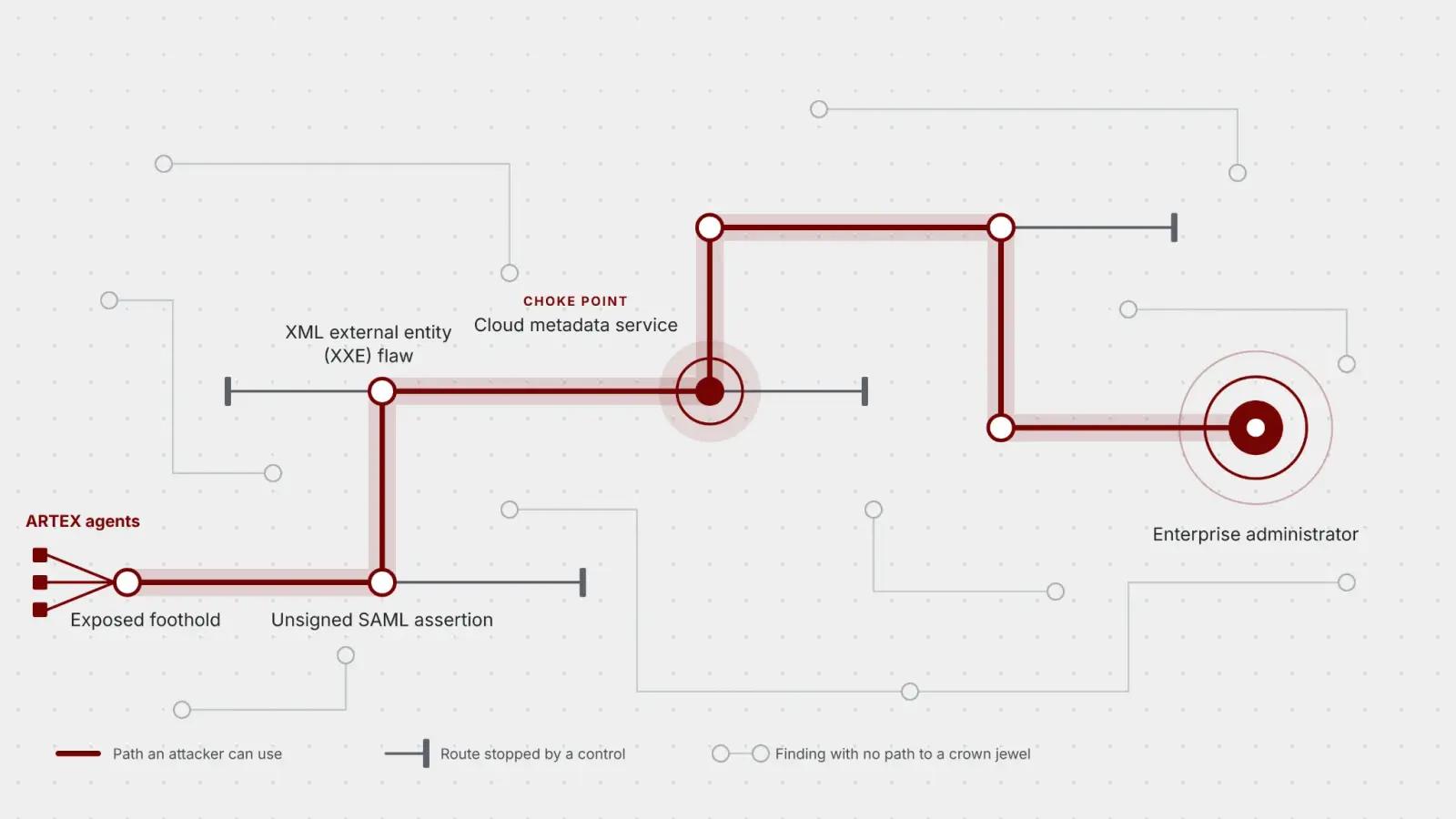
Validation. Most of the vulnerabilities found in a typical environment can never be exploited there. A few can, and agents like ARTEX are built to find exactly those. Zafran’s predictive validation capabilities assess the short list of findings the Exposure Graph says an attacker can reach. Exploitable findings move to the top of the queue, and findings a control already blocks come with proof of the rule that blocks them.
ARTEX lowers the cost of exploiting every known weakness at once. The answer is to know which of your vulnerabilities form a real path, break that path at its choke point, and prove it worked.
Forks and a commercial version keep ARTEX available, so expect more campaigns built on the same tool and the same ordinary flaws. Measure your readiness by how quickly your team can tell whether a new campaign could reach you. That is the idea behind Zafran. It works from live data in your existing tools, so your team can answer “are we exposed” without building a new process under pressure.